
Your needs, this model
Does it fit your priorities?
Does the SD6RN have documented dual-voltage operation?
Yes. The exact SD6RN page says dual voltage, and the linked SD6-family guide describes 110–125 V and 220–250 V selector positions. The selector is factory-set to 125 V; on 220–250 V the instructions require the 250 position and the HI/LO switch to remain at LO, which provides only the guide-described high-speed/high-heat mode. Confirm the actual appliance label and local supply; a plug adapter does not convert voltage.
Explore this need in the finder →Does the three-tool SD6RN package include a styling concentrator?
The exact page and linked guide identify a bristle styling brush, styling comb and detangling comb. They do not name a concentrator, so this reviewed package does not satisfy a hard concentrator requirement. Do not treat a comb or the page's marketing phrase 'directed styling' as an airflow concentrator.
Explore this need in the finder →Can I screen the SD6RN against a one-pound maximum?
No reliable pound value is printed: the exact page says 'Unit Weight 1.23 in.' I leave weight unknown, and the matcher will not treat the dryer as meeting any pound ceiling. Its dimensions row also conflicts with separate depth, width and height entries.
Explore this need in the finder →What does the linked guide say about cleaning the SD6 dryer?
The SD6-family guide identifies a hinged filter and says to keep the inlet clear. When cleaning is needed, unplug the dryer, let it cool, remove lint from the air openings with a small brush or vacuum-brush attachment, and wipe the surface with a cloth. It gives no calendar-based interval, and the model suffix should be checked on the exact appliance.
A compact dryer with a styling-tool identity
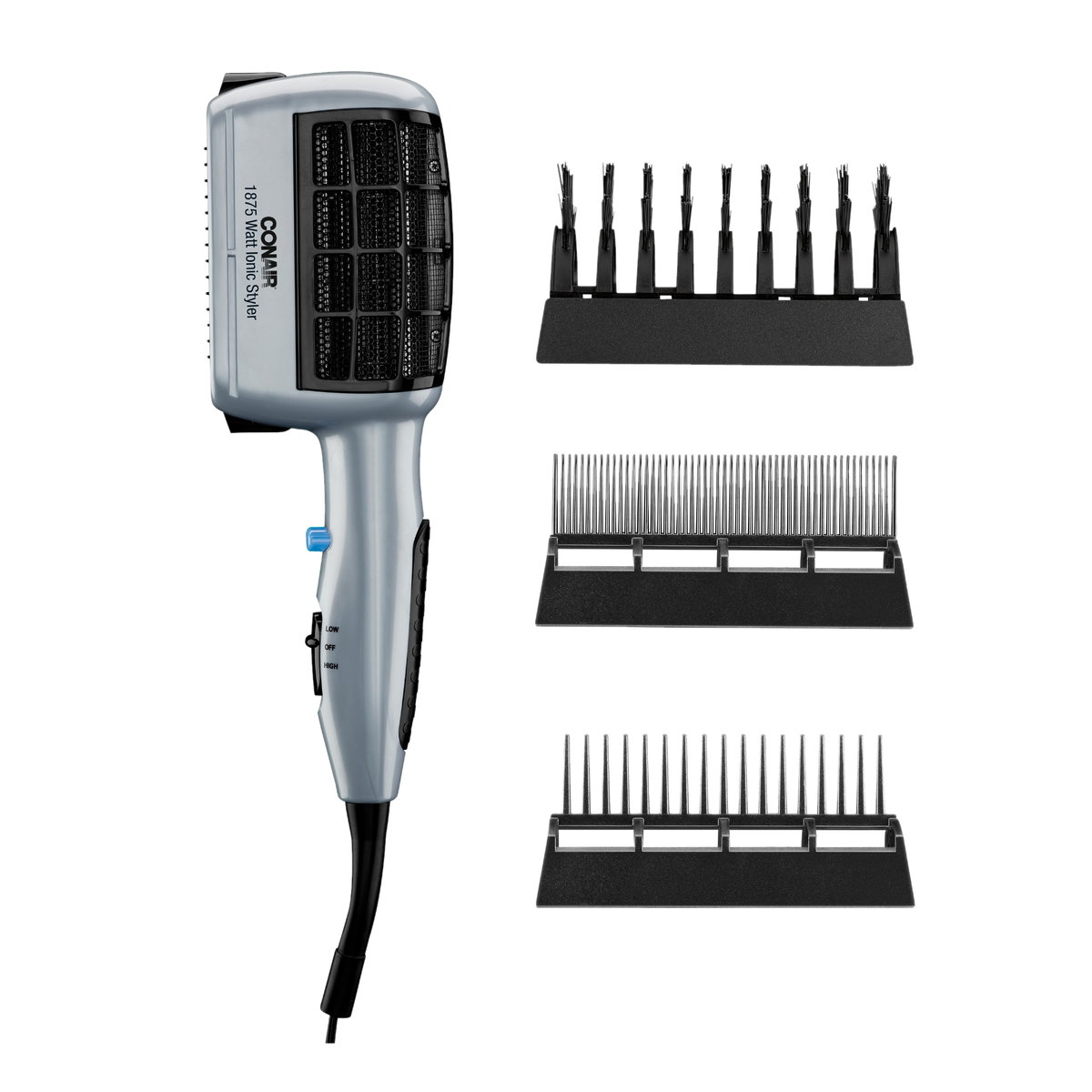
Conair’s US catalogue route identifies a blue 3-in-1 Styling Ionic Hair Dryer, model SD6RN. The exact product page describes a 1,875-watt dryer with a 5.5-foot cord, two heat/speed settings, a cool-shot button and three interchangeable tools: a bristle brush, a styling comb and a detangling comb. That makes it a different proposition from a basic dryer whose package centers on a concentrator and diffuser.
There are a few identity details worth keeping in view. The retail route and the page’s specification panel say SD6RN. Its linked instruction file is titled for SD6 models, and the image file name includes an extra L. The page itself links that guide and image, but neither internal label establishes a distinct retail SKU or explains the suffix difference. I use SD6RN as the reviewed product identity and recommend checking the model marking on the exact offer rather than treating every related code as interchangeable.
Three separate tools, three separate plans
The page assigns the bristle brush to adding volume and waves, the styling comb to straightening and the detangling comb to smoothing. The linked SD6-family styling guide gives more specific directions for the brush and detangling comb: it describes using the brush on HIGH for straightening or fullness and the detangling comb on LOW for extra volume and detangling. Its diagram labels a regular styling comb, but the text does not provide a separate technique for that head. These are the manufacturer’s suggested tasks, not measured outcomes or recommendations for a specific curl pattern.
Because the tools are interchangeable, only one is fitted for a given arrangement. The same dryer body can also be used without a head, which the guide describes as a compact dryer. None of the exact tool names is “concentrator,” “diffuser,” or “wide-tooth comb.” A comb may look broad in a picture, but the source does not identify it as a wide-tooth attachment; the matcher therefore does not count it for those named requirements. If a focused nozzle or exact detangling geometry matters, confirm that the item in the seller’s package matches the Conair list.
Dual voltage comes with a switch rule
Unlike the US-only voltage examples elsewhere in this library, the SD6RN page explicitly says dual voltage and the linked guide spells out two selector positions. The guide says the selector is set at 125 volts at the factory. On a 110–125 V supply, it allows both HI and LO heat/speed settings. For a 220–250 V supply, the instructions require the dual-voltage selector at 250 and the HI/LO switch at LO, and say not to move either switch while operating in that range. The guide describes the available output in that arrangement as high speed and high heat only.
That is a useful travel capability, but not a universal promise about the plug or local electrical installation. Confirm the appliance label and destination supply before use, and use an appropriate plug-shape adapter only if required. The guide expressly warns against a voltage converter. It also carries a 1,875-watt operating caution: combining a dryer of that rating with other appliances on one 15-amp circuit may trip a breaker. This is a setup point to plan around, not a claim that a particular home circuit will trip.
Weight and dimension fields need correction
The specification panel prints “Unit Weight 1.23 in.” Inches do not make a valid pound measurement, so this assessment leaves the pound field unknown; the finder will not treat the dryer as meeting a numerical weight ceiling. The compact-looking format and transparent image do not reveal its held mass or balance. The dimensions are also inconsistent: the page gives 3.6 by 3.6 by 14.29 inches in one row, then separate depth, width and height values of 2.75, 13 and 8.125 inches. Do not use those two presentations to promise drawer clearance or a packed footprint.
The exact page lists a limited two-year warranty. Its linked guide describes a hinged filter and says to unplug and let the dryer cool before clearing lint from the intake with a small brush or vacuum-brush attachment. It gives cleaning “when needed,” not a monthly schedule, and warns that blocked openings can lead to overheating. Follow the instructions supplied with the exact appliance, especially if the booklet cover on an offer uses a different family or code.
How it differs from a travel dryer
The Conair MiniPRO is also a dual-voltage option, but its review centers on one concentrator and a manual that limits high-voltage operation to LOW. The SD6RN instead provides multiple brush-and-comb arrangements, with a different high-voltage switch instruction. Dyson’s Supersonic Travel has one named Styling concentrator and a stated 100–240-volt range; it is not a substitute for the SD6RN’s brush/comb package. These distinctions matter more than a general label such as “travel-ready.” Choose according to the exact tool, switch procedure and source details you need.
Who should investigate this model
The SD6RN is worth comparing if you want a blue styling dryer with three separate brush/comb tools, a cool shot, a stated 5.5-foot cord and documented dual-voltage operation—and if the higher-voltage setting restriction suits your routine. It is a weak fit if a confirmed pound limit, a diffuser, a concentrator, a wide-tooth comb or a reconciled compact-storage dimension is essential. The missing or malformed fields are evidence limits, not proof the dryer cannot offer an unlisted feature.
Before ordering, check the SD6RN model marking, blue finish and exact three-tool package; verify the voltage selector instructions, destination supply and plug adapter needs; and compare the seller’s return and warranty terms with the current manufacturer material. Check current safety notices as well. This research-based assessment does not claim ownership, use, testing, measured drying time, customer experience or a particular result on any hair texture.
Key specifications
Key details at a glance
| Rated power | 1875 W |
|---|---|
| Manufacturer-listed voltage range | 110–125 v ac or 220–250 v ac with the selector set for the supply |
| Cord length | 5.5 ft |
| Heat settings | 2 |
| Airflow settings | 2 |
| Included styling attachments | 3 |
| Dual-voltage travel operation | Yes |
Use the exact model’s instructions for operating limits, supplied equipment and version differences.
Sources for this review
Sources for this assessment

Compare the dryer against your routine
Use the finder to check attachment, heat-mode, weight and travel constraints together. The assessment is based on cited manufacturer material, not hands-on testing.